Every timeline I follow right now has the same three letters in it: CAS. A screenshot of a loss, a rant about SEBI, repeat. Before joining the chorus, I wanted to actually understand what changed, why a regulator would bother changing it, whether it's worked before, and — the part almost nobody asks — whether options trading was ever supposed to be a fair fight in the first place.
What CAS actually is
CAS — the Closing Auction Session — is a new mechanism for setting the official closing price on stocks and indices with active F&O contracts. It went live on August 3, 2026, replacing a method that ran largely unchanged for years: the volume-weighted average price of the last 30 minutes of trading.
CAS works differently. Every trading day, not just expiry, there's a dedicated 20-minute window from 3:15-3:35 PM: reference price calculation (3:15-3:20), open order entry (3:20-3:25), limit orders only (3:25-3:30), with the session ending at a random point between 3:28-3:30 by design — so nobody can time an order to land in the exact final tick. The closing price itself is a call auction: pooled buy/sell orders, priced at whichever level lets the maximum volume execute.
Why SEBI actually cares
CAS isn't really about the closing print. It's about a number SEBI clearly can't unsee — over a recent three-year stretch, roughly 93% of individual traders in index options lost money, with combined losses running to something like ₹1.81 lakh crore. That's the overwhelming majority of a large, growing group of retail participants handing money to the other side of their trades, year after year — a pattern, not bad luck.
CAS isn't the only lever, and the last one has a track record worth reading
In November 2024, SEBI discontinued weekly expiry on Bank Nifty and two other indices, leaving each exchange one weekly-expiry benchmark. Since then: bigger contract sizes, higher tail-risk margin on expiry day, mandatory upfront premium collection — a steady tightening aimed at the same problem.
Did it work? Partially, with a real cost attached. Index options volume across NSE and BSE fell by more than half in the year after — notional daily traded value dropped from roughly ₹357 lakh crore to ₹207 lakh crore within weeks, and stayed down.
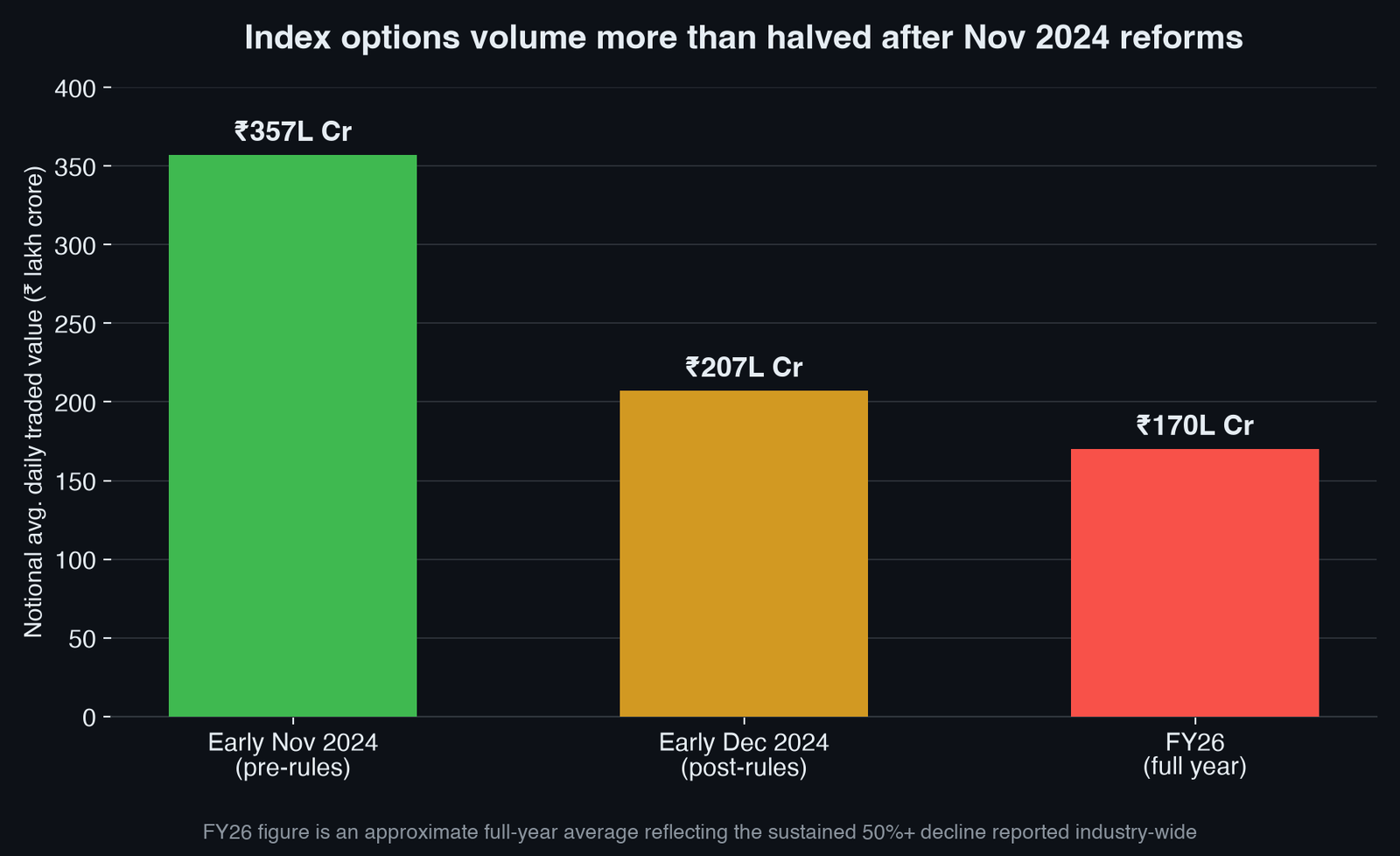
Notional average daily traded value, index options, NSE + BSE combined.
A "safer" market that's also dramatically less accessible is a real trade-off, not an unambiguous win. Some of that missing volume was reckless speculation nobody will miss; some was ordinary traders who lost a product they understood, without anything better offered instead.
The retail pain isn't just CAS — it's been stacking for two years
Losing weekly Bank Nifty wasn't the only cost. Sitting quietly under every reform is a tax that's climbed sharply in the same window. STT on options premiums went from 0.0625% before October 2024, to 0.1% from October 2024, to 0.15% from April 2026 — a 2.4x increase in under two years, on top of bigger contract sizes, upfront margin, and now a settlement mechanism nobody had time to learn before it went live.
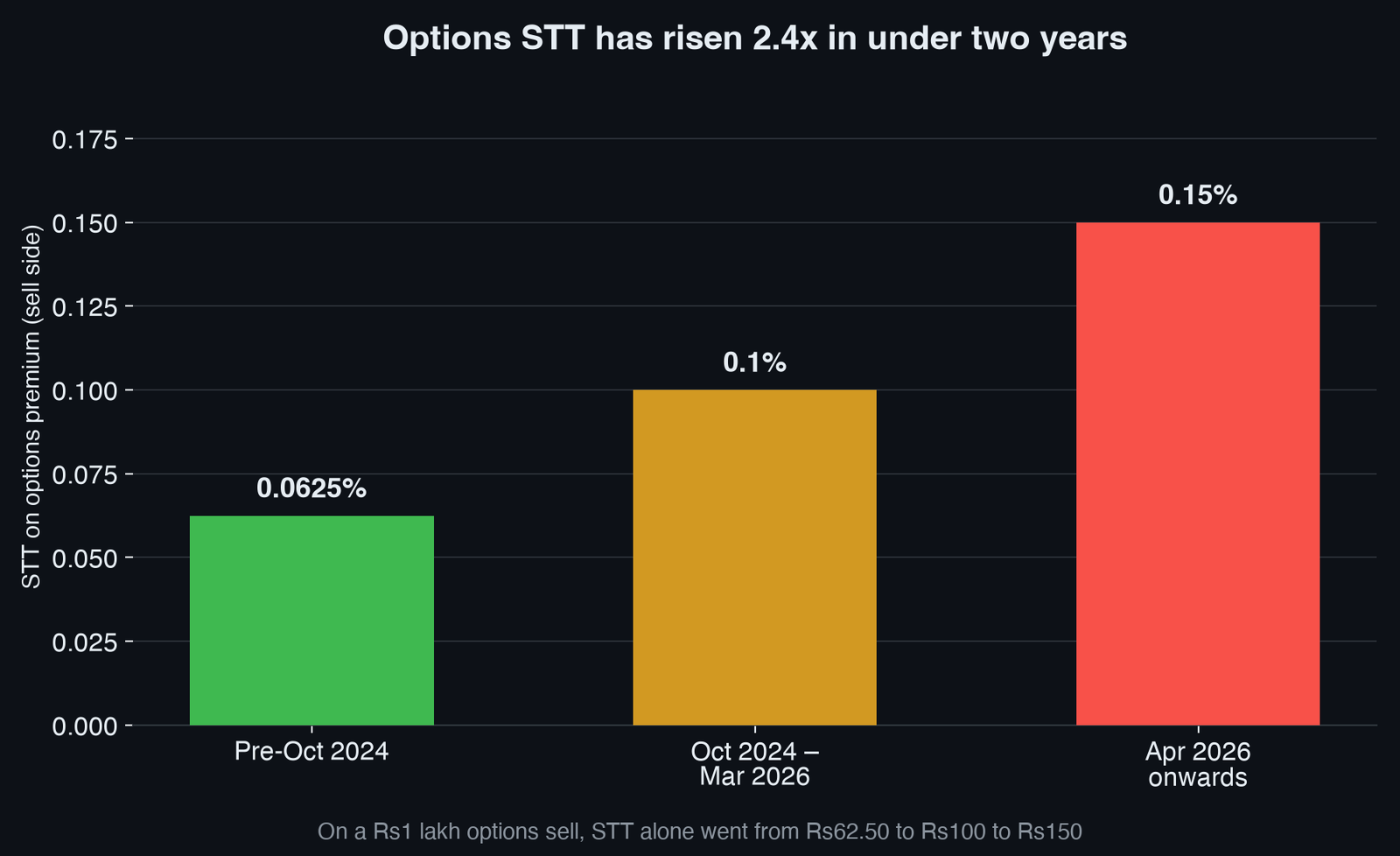
STT on the sell side of an options premium — each policy change compounding on the last.
Individually, every change has a defensible rationale. Stacked together, in under two years, on the same group of traders, they add up to something retail is right to feel: the cost of participating has gone up substantially, and very little of it has been explained as a connected story rather than separate circulars.
Is this good for the economy, or just good optics?
Household savings flowing into a product where 93% of participants structurally lose isn't a neutral fact for an economy — it's wealth transferring, often from people who can least afford it, to better-capitalized counterparties. A regulator with an investor-protection mandate has a legitimate interest in that. At the same time, derivatives aren't purely a casino — they hedge real risk and add liquidity that makes the cash market function better, a distinction worth keeping straight even when the headlines blur it. Restricting access too bluntly can push determined speculators toward less regulated alternatives instead of protecting them. SEBI is threading a real needle, and CAS's rocky first few weeks are evidence it hasn't landed every calibration yet.
If there's a genuine hope worth holding here, it's specific: that SEBI keeps refining this rather than declaring it finished. Maybe that's a cleaner separation between how equity closing prices get set and how option settlement actually reconciles against them, so a thin auction window isn't single-handedly deciding what an entire option chain owes. Maybe it's SEBI genuinely absorbing retail feedback from these first few weeks — the confusion, the cost stacking, the "nobody explained this as one story" frustration — instead of treating the rollout as complete just because the mechanism is technically live. The honest ask isn't "give us back the volatility." It's "keep building a platform that's actually fair to the people funding it," and three weeks in, that work is clearly still in progress.
The part that doesn't get said enough: nobody promised this would be fair
Options trading was never designed to be a level playing field where everyone wins if they try hard enough. It's zero-sum by construction — every rupee made on one side is a rupee lost on the other, before costs, and costs make the aggregate negative-sum. Someone is always on the losing side of every contract. That's not a flaw CAS introduced — that's what the instrument is, and it was true long before this month.
Participation is voluntary, legal, and every risk characteristic — time decay, leverage, binary payoffs — is documented and freely available before you trade. This is closer to a specialized professional discipline than investing, and treating it like the latter is where most damage happens. When a trade loses, the honest accounting is that you took a defined-risk bet in a legal, disclosed, zero-sum game — not that the game was owed to you.
None of that excuses an actual malfunction. On day one, August 3, Nifty's official close jumped roughly 201 points in the fifteen-odd minutes between regular trading ending and the CAS auction settling — enough that people assumed trading had continued past 3:15, when NSE later confirmed only indicative equilibrium prices were being calculated until the auction settled.
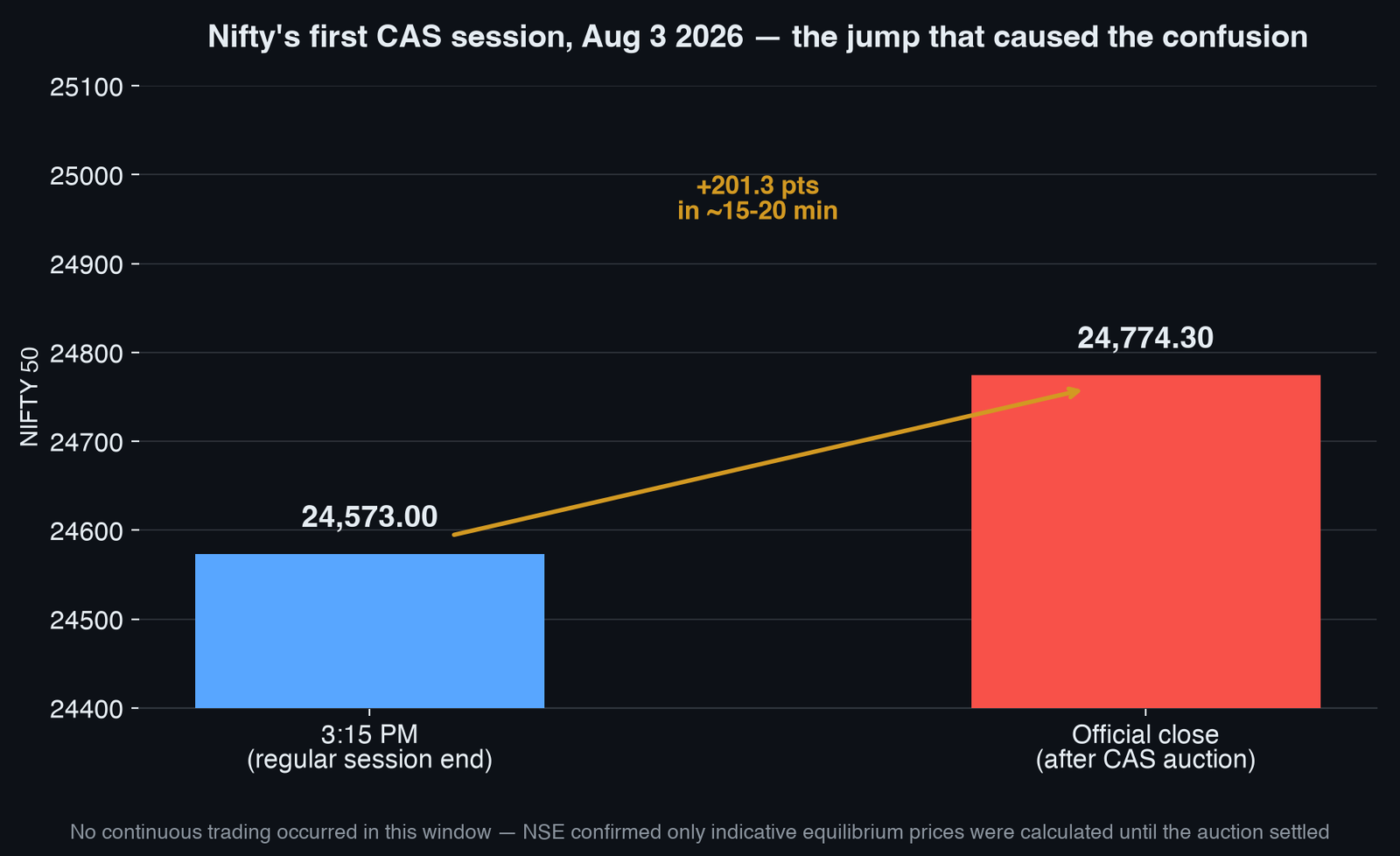
NIFTY 50 — 3:15 PM regular-session price vs. the official CAS-settled close, Aug 3, 2026.
And the dark joke about "who's really driving CAS" had a real answer, at least once: SEBI's own interim order named Copthall Mauritius Investment Ltd, alongside a domestic broking entity, alleging aggressive cash-market orders used to influence SENSEX's closing auction to benefit a derivatives position. SEBI impounded ₹3.67 crore and banned both entities inside six days. SEBI's chairman has said CAS is "here to stay," and that manipulation is actually easier to catch under it than the old averaging method — a concentrated auction leaves a cleaner footprint.
What the tape actually shows, away from the headline case
Away from the one confirmed manipulation case, here's what an ordinary session's order flow looks like read properly — Thursday's (Aug 27) SENSEX 77300 PE.
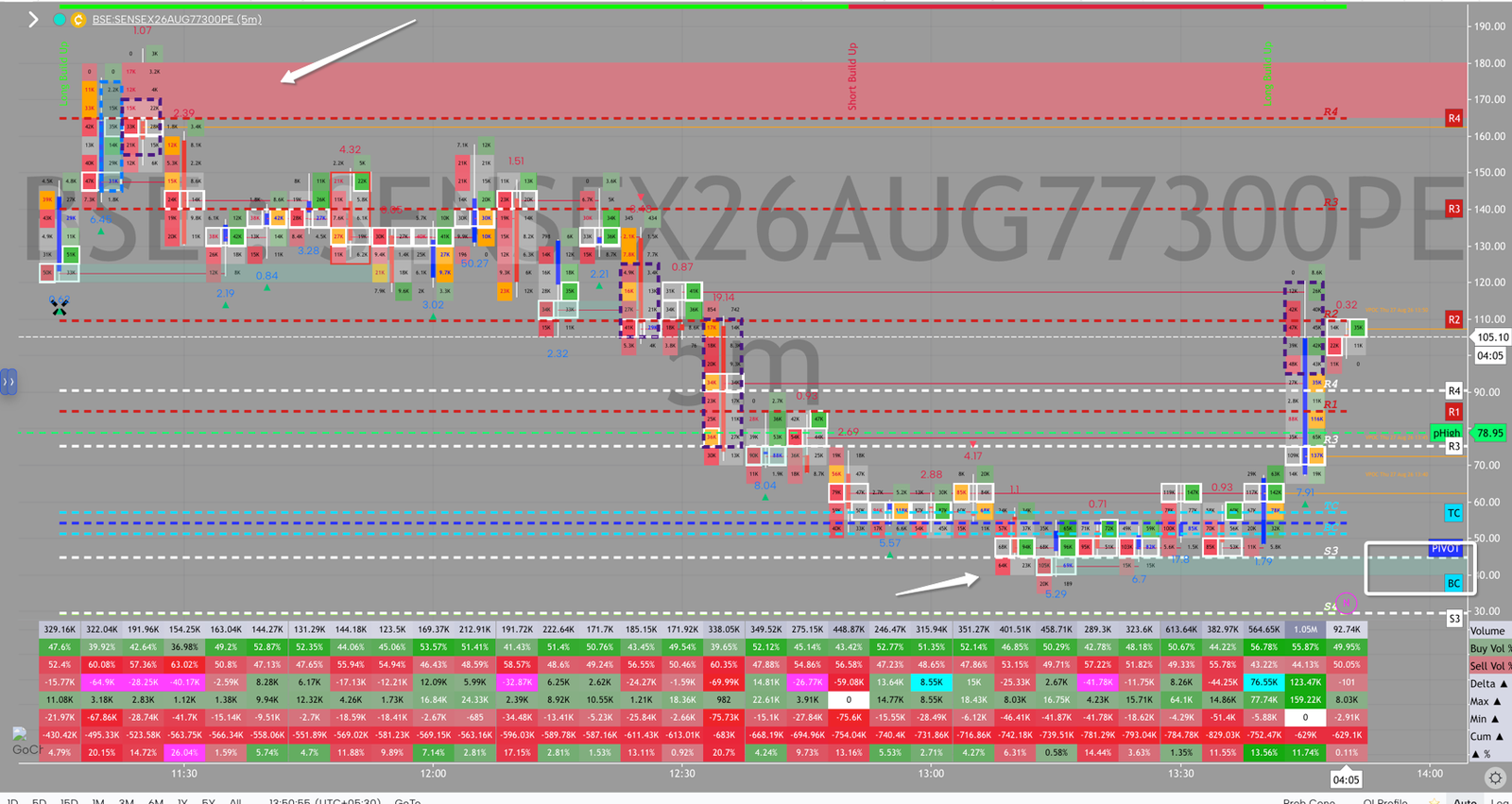
BSE:SENSEX26AUG77300PE, 5m footprint — expiry day, August 27, 2026.
Sustained heavy negative delta almost the whole session: -430K, -523K, -569K, -581K, -596K, -611K, building to -668K, -694K, -742K, -784K, -829K through the back half. Continuous large-size selling, all day. Premium fell ₹190 → ₹50. That's ordinary large-size positioning: consistent conviction held through the session, not reacted into at the close.
What I actually run instead
I'm not claiming I've solved market structure — I haven't. What I have is a live algo that doesn't argue with CAS, circulars, or whatever changed this week. It just runs, and the numbers are the numbers:
- July 2026: +₹37,252 net, 18W 5L, 4.61% ROI on real SEBI-margin capital (1 lot each, NIFTY + BANKNIFTY + SENSEX combined)
- August 2026 (MTD): +₹29,599 net, 14W 5L, 3.64% ROI, annualizing out to roughly 48-50% at this run-rate
Those numbers aren't a promise about next month. What they demonstrate is a system that doesn't need CAS, or whatever comes after it, to behave a certain way to keep functioning.
How to actually safeguard yourself, since the rules of the game were never in question
If the deal was always "zero-sum, disclosed, voluntary, someone loses every contract," the only real question is whether you're equipped to be on the winning side more often. A few things that actually move that needle:
Assume the mechanism will keep changing, because it's brand new. Category II stocks are still on the old method, for now. A system built to survive only today's rules is built to break the next time they move.
Read order flow as it happens, not after the fact. The delta building through Thursday's session above was there the whole time, on the same feed anyone can watch.
Relative Strength (RS) tells you what's actually leading — measurable, not a vibe. VCP (Volatility Contraction Pattern) tells you when a leading stock is ready. CPR (Central Pivot Range) tells you where the levels that matter are. None of these three alone is a strategy — together, they're a filter that keeps you in stocks with a real reason to move, entered where risk is genuinely small.
If you want the full breakdown of how I actually read CPR, pivots, and order flow session to session, that's here: Reading the Market — CPR, Pivot, Order Flow. And if you want the RS/VCP screener itself rather than take my word for it, it's live at alpha.leofinwise.in — filter by RS rank, base quality, and Stage 2 breakout status.
One more thing worth saying plainly: leverage without a plan is how CAS turns into a career-ending week instead of a bad afternoon. If you're pledging debt funds or using margin to size in, do it because the setup earned it — not because the position "felt right."
CAS isn't going anywhere. Neither is the fact that options were always a harder, more zero-sum game than most people were told when they opened their first contract. The traders doing fine three weeks in aren't the ones still arguing about whether that was fair. They already knew.
Questions on any of this, or want to compare notes on your own system — drop me a note.
Sources: SEBI/NSE Closing Auction Session overview · SEBI flags alleged manipulation in first CAS order · SEBI bars two entities, impounds ₹3.67 crore · Outlook Money on the Aug 3 CAS jump · Options volumes decline 50%+ in FY26 · SEBI's Nov 2024 weekly-expiry rationalisation · STT increase on F&O explained